Part 4 of 6 in the New Frontier series.
The Moon Is Not a Destination
384,400 km. A little under two light-seconds. Far enough that a radio message takes just over a second each way, close enough that we have sent twelve humans there and brought them all back alive. The Moon has been sitting in our sky for 4.5 billion years, and for most of human history, it was nothing more than a navigation aid and a reason to write poetry.
That framing is becoming obsolete fast.
The Moon has 1.62 m/s² surface gravity — one-sixth of Earth’s. No meaningful atmosphere. A surface temperature that swings from +127 °C in direct sunlight to −173 °C in shadow — and in the permanently shadowed craters near the poles, a bone-deep −230 °C that has preserved water ice for billions of years. A 14-Earth-day-long night followed by a 14-Earth-day-long day.
Every single one of those numbers, which sound like engineering nightmares, is actually a resource.
Low gravity means it costs a fraction of the energy to launch mass off the Moon compared to launching it off Earth. A hard vacuum means you can do certain manufacturing processes — from metallurgy to semiconductor deposition — without the contamination and oxidation that plague Earth-based factories. Extreme thermal cycles can drive industrial processes. Permanently shadowed craters preserve water ice that took billions of years to accumulate. Ridgelines near the South Pole receive near-constant sunlight for solar power generation.
The Moon is an industrial site waiting to be opened.
This article is about how we do that — the technologies, the timelines, the economics, the risks, and the self-reinforcing bootstrapping cycle that could, within one or two human generations, turn the Moon into the supply base that makes the rest of the solar system accessible.
Artemis Base: The Timeline as It Stands
The Artemis program has undergone more schedule revisions than I care to count, but 2026 has brought genuine structural clarity. The most significant single decision: the cancellation of the Lunar Gateway in March 2026, with approximately $20 billion redirected from the orbital station concept toward a permanent surface base. That is a meaningful strategic shift. Gateway was always an elegant idea in search of a purpose; a surface base is the purpose.
Here is where the program stands right now:
-
Artemis III (late 2027) — a crewed LEO rendezvous and docking demonstration. Crew meets the SpaceX Starship HLS and Blue Origin Blue Moon landers in Earth orbit. No lunar landing — think Apollo 9: validating the vehicles before committing to the surface. The SLS core stage is already shipping to Kennedy Space Center. A full-scale Blue Moon MK2 landing cabin prototype is at NASA’s Johnson Space Centre for crew training.
-
Artemis IV (early 2028) — the first crewed lunar landing since Apollo 17. Targeting the south pole. Phase 1 base infrastructure: habitat precursors and initial ISRU testing. The mission I watch most closely — the transition from “we visited” to “we started building.”
-
Artemis V (late 2028) — second crewed landing in the same year. Base construction begins in earnest. The first precursor nuclear fission power units, targeting approximately 10 kW from early-phase Kilopower-class fission systems. That number matters: 10 kW is enough to run initial ISRU equipment through the two-week lunar night. Without nuclear power, any base is solar-dependent and goes dark for 14 Earth days — catastrophic for continuous industrial operations.
-
Robotic lander cadence from 2027 — monthly landings, carrying equipment, supplies, and infrastructure. This is the logistics pipeline that makes everything else possible.
-
Continuous human presence target: 2032 — the point at which the base shifts from “expedition” to “station.”
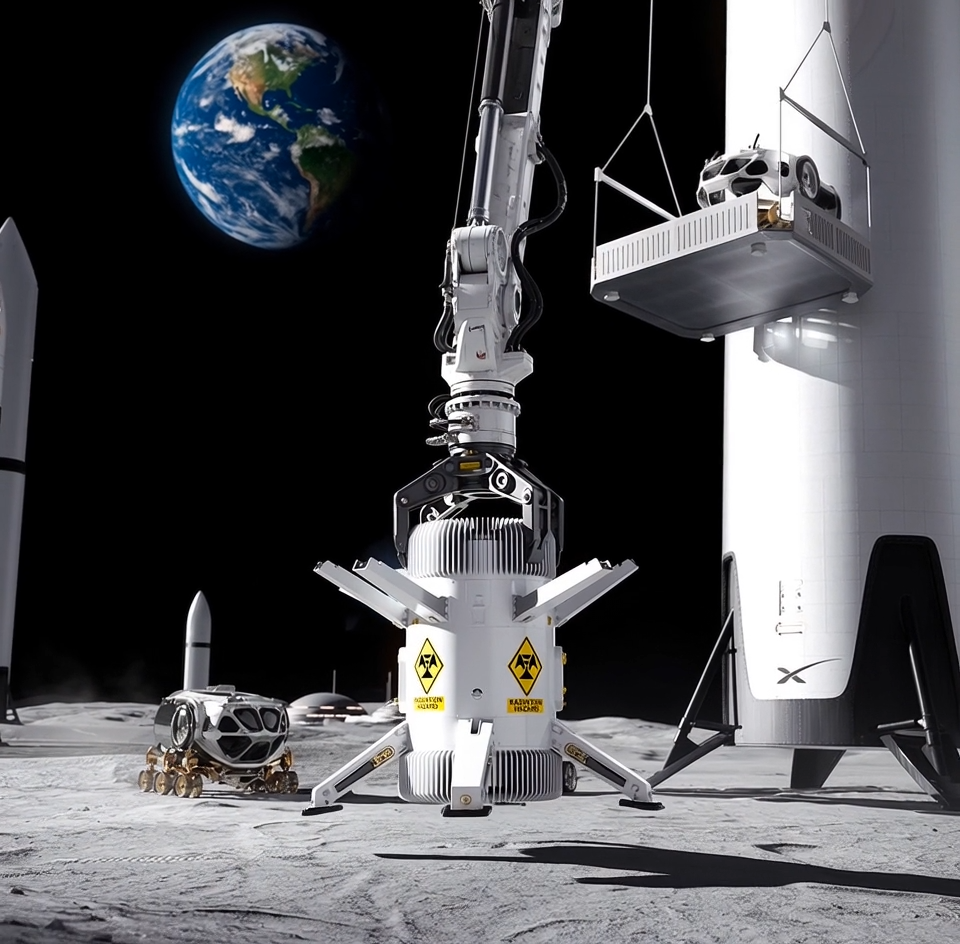
Nuclear fission surface power deserves its own paragraph because it is genuinely the critical path item for lunar industry. The 14-day night is an existential constraint on any ISRU or manufacturing process that requires continuous operation. Fission provides power regardless of the sun’s angle. The Kilopower program proved the concept at laboratory scale; the Fission Surface Power (FSP) project is now in the development and demonstration phase — not yet deployment-ready, but on the critical path for any industrial-scale lunar operation. Everything that follows in this article — every piece of industrial equipment, every manufacturing line, every export operation — depends on getting reliable power through the lunar night.
ISRU: Making Stuff from Moon Stuff
In-Situ Resource Utilization is the polite engineering term for “stop bringing everything from Earth and start using what is already there.” It is the single most important concept in space settlement economics, and the Moon is where it first receives its real test.

Water Ice: The Foundation of Everything
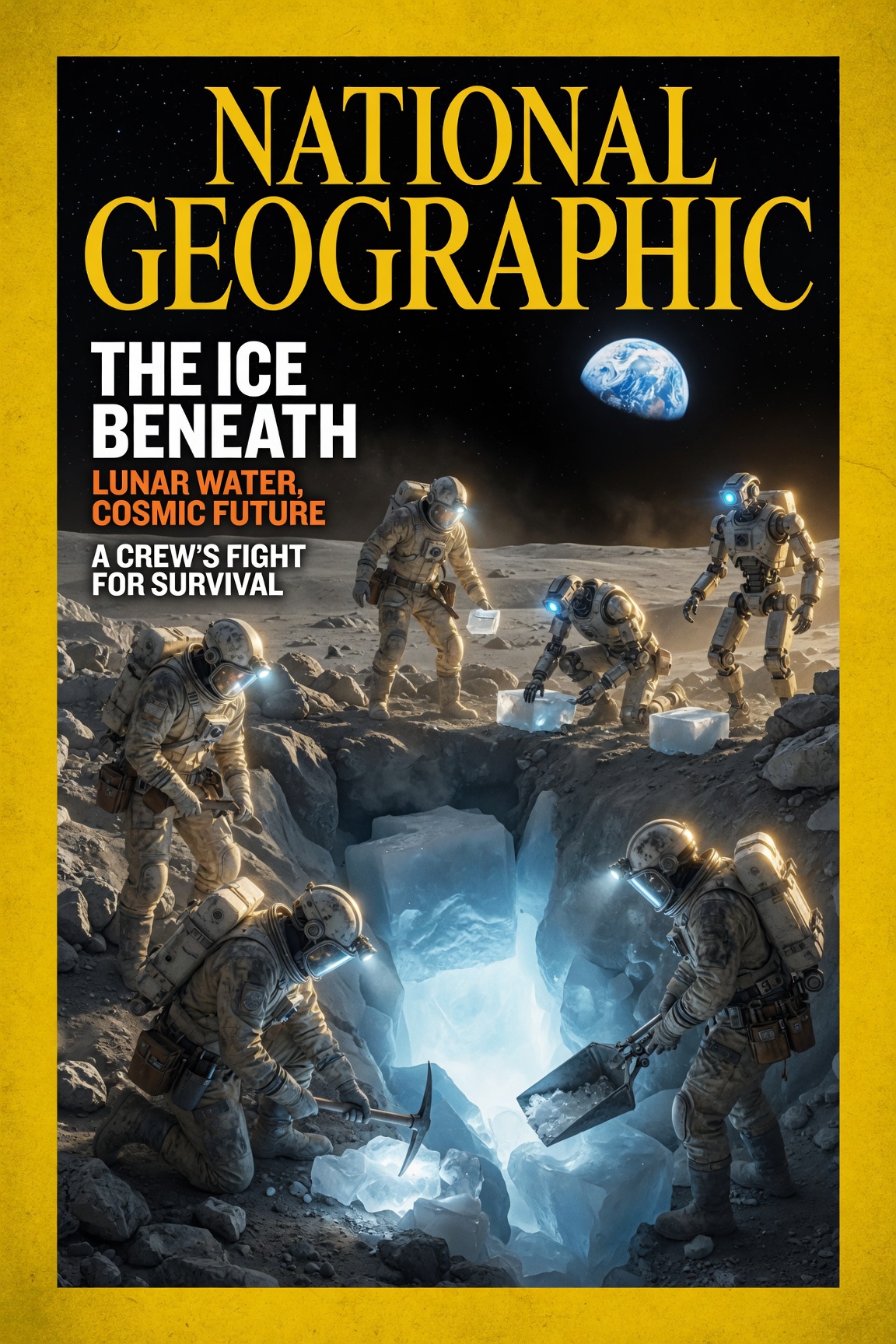
The south pole’s permanently shadowed craters contain water ice — confirmed by multiple orbital instruments, with estimates ranging from hundreds of millions to potentially billions of tonnes depending on how deep the deposits go and how accessible they are. At −230 °C, this ice has been stable for geological timescales.
The process chain is elegant:
- Mine regolith and ice from shadowed craters using thermally isolated excavation equipment
- Purify the extracted water through distillation and filtration
- Electrolyze using solar or nuclear power — water splits into hydrogen and oxygen
- Liquify and store as LOX/LH₂ — liquid oxygen and liquid hydrogen — the highest-performance chemical propellant combination available
- Use surplus oxygen directly for life support
Every kilogram of propellant produced on the Moon replaces a kilogram that would otherwise be launched from Earth. At current launch costs, that is a meaningful number per kilogram. At the scale of a crewed Mars mission — which might require hundreds of tonnes of propellant staged in lunar orbit or on the surface — it is the difference between economically feasible and economically impossible.
Oxygen from Regolith
Here is something that tends to surprise people: the lunar regolith is roughly 40–45% oxygen by mass. That oxygen is locked up in metal oxides — silicates, ilmenite (iron-titanium oxide), and similar compounds — but it is there, and it can be extracted.
Blue Origin’s “Air Pioneer” demonstration is specifically targeting oxygen extraction from regolith. The ilmenite reduction process uses hydrogen to reduce iron-titanium oxide to iron, titanium, and water, which you then electrolyze to recover the hydrogen and keep the oxygen. It is a closed-loop process that gets more efficient the more power you feed it.
The chemistry is well understood. The real engineering challenge is building equipment that operates reliably in the thermal cycling, vacuum, and dust environment of the lunar surface for years without maintenance. That is the hard part.
Metals and Construction Materials
Oxygen extraction produces metals as valuable byproducts:
- Iron — for structural components, tools, and machinery
- Aluminum — for structural elements and electrical conductors
- Titanium — for high-strength, corrosion-resistant applications
- Silicon — the foundation of both glass and photovoltaic cells
The ISRU operation extends well beyond propellant and air. The metallic byproducts of oxygen extraction are the raw material for a lunar construction industry. Every tonne of oxygen extracted from ilmenite yields iron and titanium that can be shaped into parts.
Helium-3: The Dual-Use Angle
Helium-3 is a non-radioactive isotope that barely exists on Earth — our atmosphere bleeds it away. On the Moon, the solar wind has been implanting He-3 into the top few meters of regolith for billions of years. Estimates suggest roughly 1 million tonnes of He-3 are available in the lunar regolith, though extraction would require processing enormous volumes of material.
The company Interlune is developing a pilot system targeting extraction at rates of over 100 tonnes of regolith per hour. Their business case rests on two markets: fusion fuel (He-3 is the ideal fuel for aneutronic fusion, which produces almost no neutron radiation) and quantum computing coolant (dilution refrigerators that cool quantum processors to millikelvin temperatures currently rely on scarce He-3, and demand is growing with the quantum computing industry). Interlune has a Department of Energy order targeting 2029 delivery.
Crucially, He-3 extraction is inherently dual-use. Extracting He-3 requires processing massive volumes of regolith, and that processing yields oxygen, hydrogen (which becomes water), and other volatiles as byproducts. The economics of He-3 extraction thus subsidize the ISRU operations that produce propellant and life support consumables.
Lunar Manufacturing: From Raw Material to Finished Goods
ISRU provides raw materials. Manufacturing turns those raw materials into things with value. This is where the Moon stops being an outpost and starts being a factory.
Solar Panels from Lunar Silicon
Silicon is abundant in lunar regolith. The purification and deposition processes required to turn raw silicon into photovoltaic cells are energy-intensive but not exotic — they are the same processes used on Earth, adapted for a vacuum environment where many of the contamination problems actually become easier to handle.
Casey Handmer, whose analysis of lunar industrialization has been among the most quantitatively rigorous I have read, published work in February 2026, estimating that a fully operational lunar solar panel production line could be established within approximately 10 years of first investment — an ambitious projection that assumes sustained investment and successful ISRU bootstrapping. His May 2026 analysis extended this further: the same silicon processing and deposition infrastructure that makes solar panels could, with relatively modest adaptation, produce the specialized chips used in AI inference — the neural processing units (NPUs) that run trained models.
The logic is compelling. NPUs are high-value, low-mass products. A single shipment that fits in a small lander could carry billions of dollars of computing hardware. Lunar manufacturing, using local silicon and powered by locally generated electricity, could produce these chips at costs that undercut Earth manufacturing once the production infrastructure is in place — because the raw material is free and the energy comes from the sun.
This is a straightforward application of industrial economics to a new location. It just requires getting the first factory built.
3D-Printed Habitats
Launching pre-built habitat modules from Earth is expensive and constrained by the dimensions of rocket fairings. Printing habitats from local regolith at scales that match available power and materials, not launch capacity.
Three programs are leading this space:
-
ICON’s Project Olympus (NASA-funded) — ICON is the company that 3D-prints concrete houses on Earth using their Vulcan system. Project Olympus adapts this concept for lunar regolith, developing a large-scale additive manufacturing system that can construct habitats directly from processed local material.
-
ESA’s RegoLight and PAVER programs — focused specifically on microwave sintering of regolith. Instead of mixing regolith with a binder, microwave sintering heats the material until its glassy components fuse. The resulting bricks and panels have been tested at compressive strengths exceeding 20 MPa — comparable to industrial concrete. ESA’s work includes Redwire-produced demonstration bricks that meet this threshold.
-
Inflatable plus regolith shielding — the near-term architecture works without fully printed structures. Inflatable habitat modules launched from Earth provide the initial pressurized volume, and 2–5 meters of regolith piled on top provides both radiation shielding and protection against micrometeorites. The long-term vision replaces the inflatable core with a fully printed structure, but the intermediate approach is buildable today.
Sintered Landing Pads
Every rocket that lands on or launches from the lunar surface ejects high-velocity regolith particles that sandblast anything within line of sight. Repeated use of an unimproved landing site will destroy nearby equipment. The solution is sintered landing pads — regolith fused in place by concentrated microwave or solar energy to create a hard, stable surface.
This is one of the first ISRU applications that is both technically straightforward and economically mandatory. A logistics operation on the Moon requires landing pads, and landing pads require ISRU. It is a chicken-and-egg problem that the first robotic missions need to solve before anything else can scale.
Mass Drivers: The Killer App
If ISRU is the most important concept in lunar settlement economics, mass drivers are the most important single piece of infrastructure for turning the Moon into an export economy.
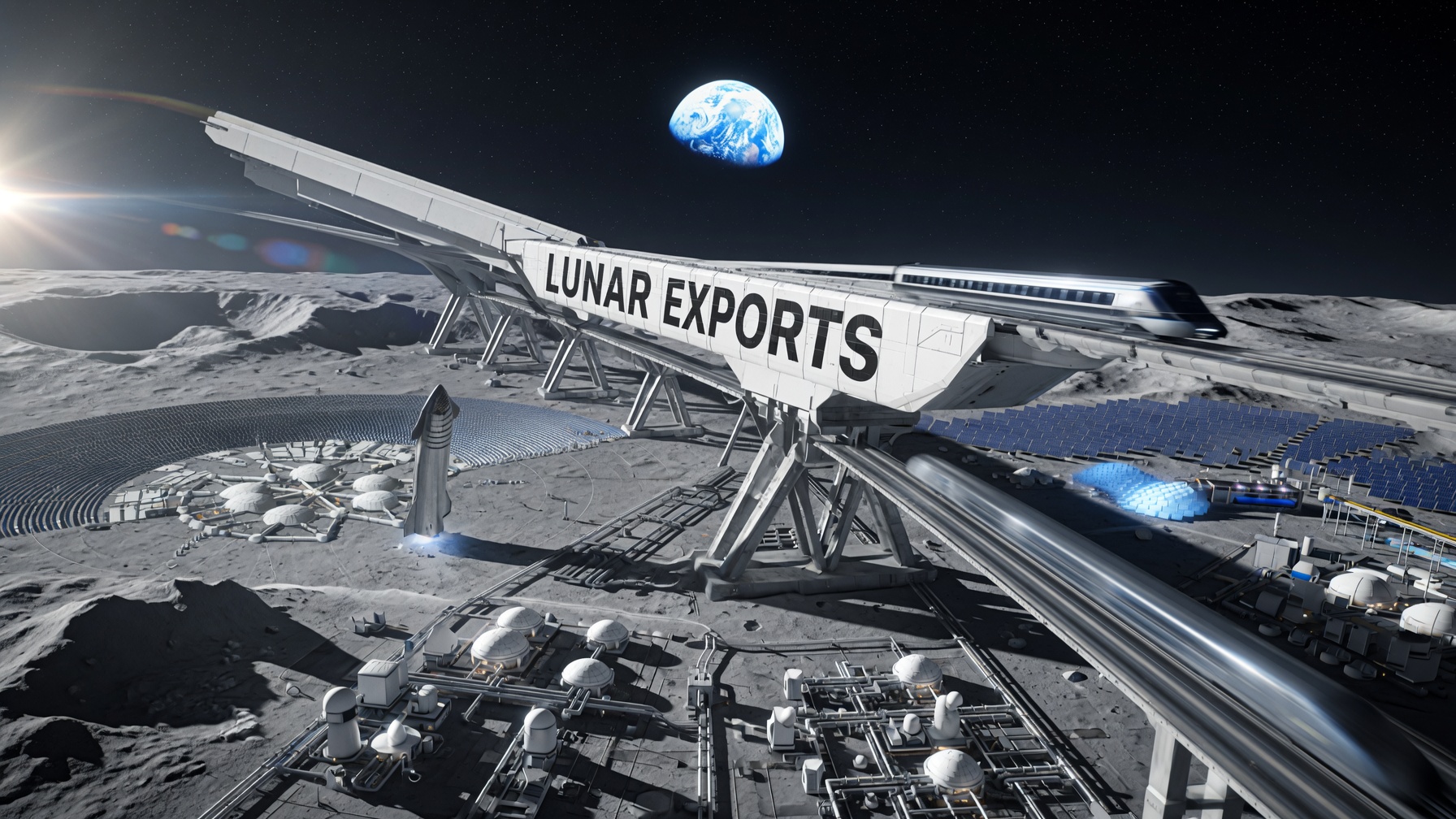
A mass driver is an electromagnetic launcher — a long track with superconducting coils that accelerate a payload to lunar escape velocity (approximately 2.4 km/s) using electricity and no propellant. The payload, once released, travels to a collection point in lunar orbit or beyond, where it is picked up and redirected.
Gerard O’Neill proposed this concept in the 1970s as the foundation for space industrialization. The technology required — high-field superconducting magnets, precision power electronics, autonomous guidance systems — has advanced dramatically in the intervening decades. What was speculative in 1975 is engineering in 2026.
The economics are striking. Getting a kilogram from Earth to low Earth orbit costs roughly $1,000–10,000 depending on the launcher. Getting that same kilogram from lunar escape velocity to LEO using propellant costs a fraction of that, because lunar gravity is only one-sixth of Earth’s and you are already most of the way up. But a mass driver eliminates propellant costs entirely — it is pure electricity generated by solar panels or fission reactors. The marginal cost of launching a kilogram via a mass driver approaches the cost of the electricity used.
According to Casey Handmer’s May 2026 analysis, the potential revenue from a single operational mass driver could reach $100 billion per year at scale — assuming a mature cislunar economy with sustained demand for lunar-origin materials — sourced from exporting construction materials, propellant, and manufactured goods to cislunar space and beyond. The American Foreign Policy Council’s May 2026 report on lunar industrialization identifies mass drivers as dual-use infrastructure: economically transformative and strategically significant for whoever controls the high ground of cislunar space.
NASA’s FLOAT (Flexible Levitation on a Track) project and DARPA’s LunA-10 program are both exploring the enabling technologies. Neither is a mass driver yet, but they are building the components.
The Enemy: Lunar Dust
I need to stop here and talk about dust.
Everything I have described above — the ISRU systems, the 3D printers, the solar panels, the mass drivers — faces a common adversary that is more persistent, more insidious, and more destructive than the vacuum, radiation, or temperature swings. It is the regolith itself.
Lunar dust bears zero resemblance to terrestrial dust. On Earth, billions of years of water, wind, and biological activity have rounded and smoothed particles through erosion. The Moon has none of that. Lunar regolith particles are jagged, fractured, glassy shards — many of them under 20 micrometers in diameter. Under a microscope, they look like broken glass, which is essentially what they are: silicate minerals shattered by billions of years of micrometeorite impacts, with no mechanism to soften the edges.
They are also electrostatically charged. Solar ultraviolet radiation and the solar wind charge the surface, and the dust particles pick up that charge. They cling to everything. They cling to suits, to visors, to solar panels, to bearings, to seals. They resist brushing; they have to be physically removed, and the removal process scratches whatever surface they were adhering to. Fine enough particles actually levitate above the surface in an electrostatically suspended haze — invisible to the naked eye but present, drifting, settling on every horizontal surface.
The Apollo astronauts, who spent a few days on the surface, identified dust as their single biggest operational problem. Suits stiffened because dust worked into the fabric. Visors became scratched and hard to see through. Equipment brought back inside the cabin smelled of gunpowder — the smell of fresh lunar regolith reacting with cabin air. The astronauts had dust in their noses, in their lungs, embedded in their skin. After just a few lunar surface EVAs.
Now imagine running an industrial operation for years.
Dust at an industrial scale is a systems-level problem. Coating a single component with a protective nanomaterial solves nothing by itself. Every bearing, every seal, every optical surface, every solar cell, every joint in every structure is subject to continuous abrasion and electrostatic contamination. A solar array that loses 20% of its output to dust accumulation in the first six months undercuts the power calculations the base depends on.
The mitigation layers under development address different aspects of the problem:
- Nano-coatings — hydrophobic and electrostatic-repelling surface treatments that reduce adhesion without affecting material properties
- Electrodynamic Dust Shield (NASA) — a system of electrodes that generate traveling electric fields to physically move dust off surfaces; demonstrated in laboratory conditions
- Multi-stage airlocks — preventing dust from entering pressurized volumes requires not a single airlock but a cascade of progressively cleaner chambers, with dust removed at each stage
- Sintered and paved surfaces — immobilizing the dust in place around the base to prevent it from being kicked up by movement, rocket exhaust, or thermal cycling
- Sealed robotics — designing robotic systems with fully sealed joints and bearings, no exposed lubricants, and dust-tolerant mechanisms
- Tesla’s Optimus robot — mentioned in the context of dust tolerance because the Optimus design philosophy emphasizes robust joints and sensors that can operate in degraded conditions; lunar operations will need robots that keep functioning when coated in dust rather than failing gracefully
This topic is genuinely too large to do justice to in a section of a broader article. I am planning a dedicated piece — “Regolith Is Unearthly Filth” — that goes deep on the physics, the biology, the engineering challenges, and the current state of mitigation technology. It will be a spinoff from this series. Consider this a preview.
The point for now is simple: every cost estimate and timeline projection for lunar industrialization must explicitly account for dust — those that skip it are optimistic. The good news is that dust is a solvable problem — it just requires engineering effort, operational discipline, and infrastructure investment that compounds over time.
The Lunar Export Economy
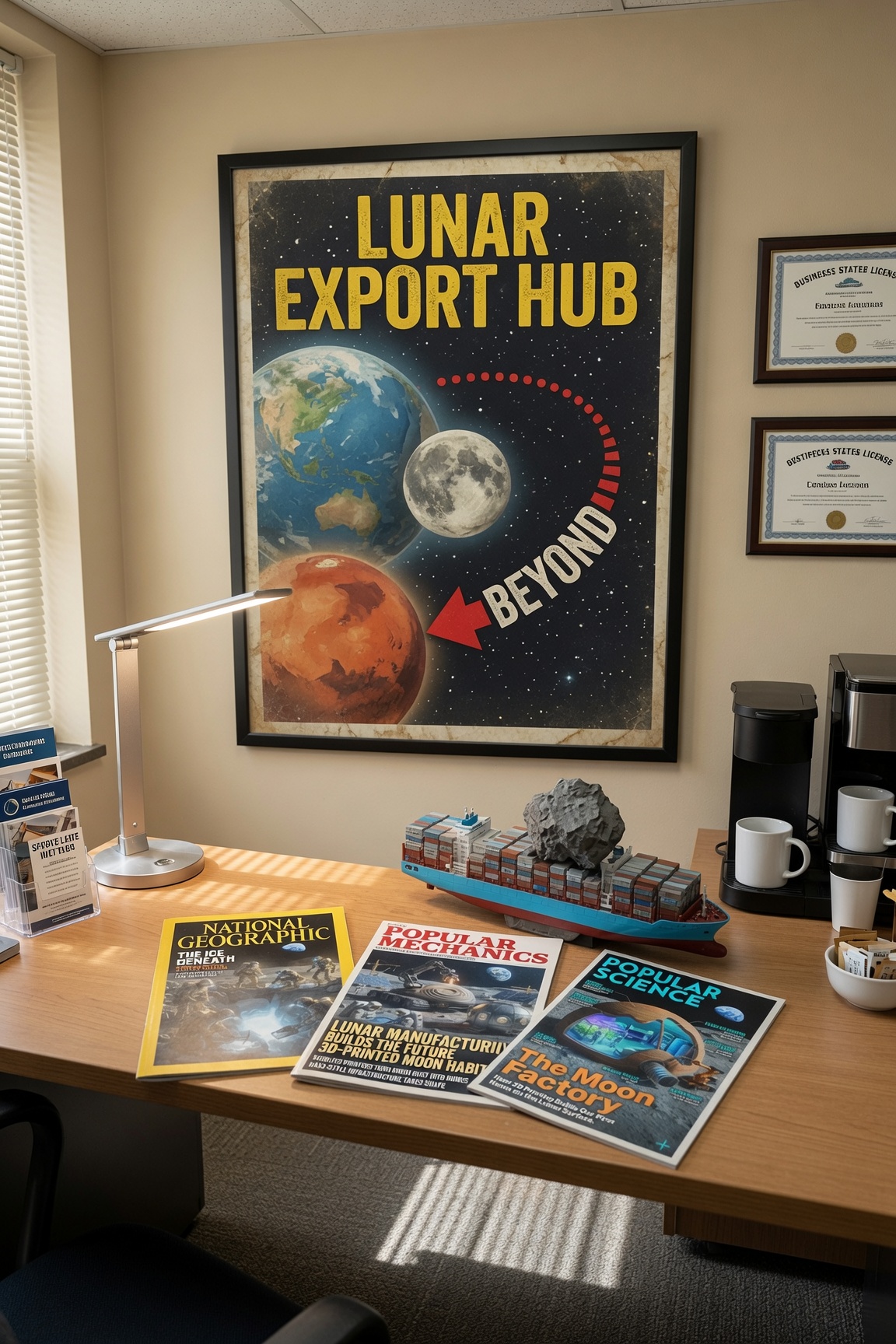
At some point, the Moon needs to pay for itself. The question is what it exports, to whom, at what price.
Propellant: The First and Most Obvious Market
Propellant is the simplest case. Every kilogram of LOX/LH₂ or other propellant produced on the Moon and delivered to a depot in lunar orbit or low Earth orbit replaces a kilogram that would otherwise have to be launched from Earth.
The cost savings depend on the launcher and the orbit. At current launch costs:
- A kilogram delivered to low Earth orbit costs roughly $1,000–$10,000 depending on the vehicle
- A kilogram of lunar propellant delivered to cislunar space costs whatever the marginal cost of ISRU production plus mass driver launch amounts to, which, at scale, is projected to be dramatically lower
- The savings for a deep space mission that needs to refuel in lunar orbit rather than launching all propellant from Earth are potentially hundreds of millions of dollars per mission
The market already exists. Artemis missions, commercial deep space missions, and any crewed Mars architecture all require propellant in cislunar space. The only question is whether lunar production can achieve the reliability and cost targets to compete with Earth-launched propellant.
Helium-3: The Premium Export
Helium-3 at approximately $20 million per kilogram is the highest-value commodity that can be extracted from the lunar surface. To put that in context: at that price, a single kilogram of He-3 is worth approximately 10 times its weight in gold. A single Starship cargo bay could theoretically carry enough He-3 to be worth multiple billions of dollars.
The markets are real and growing:
- Fusion fuel — He-3 is the ideal fuel for aneutronic D-He3 fusion reactions, producing minimal radiation and enabling direct energy conversion. No commercial fusion reactor runs on He-3 yet, but multiple programs are targeting this fuel cycle precisely because of its advantages.
- Quantum computing coolant — dilution refrigerators that cool superconducting quantum processors to millikelvin temperatures require He-3. As quantum computing scales, demand for He-3 grows proportionally. The current supply is constrained; a reliable lunar source would transform the market.
Interlune’s commercial model links these two markets, and the DOE’s 2029 delivery order provides a concrete near-term demand signal. The company’s He-3 extraction process, as noted above, also produces oxygen and hydrogen byproducts — making it complementary with rather than competing against propellant production.
Manufactured Components for Orbital Infrastructure
This is the category that most people underestimate. Orbital data centers, communications platforms, solar power satellites, and deep-space infrastructure all require large quantities of structural materials — aluminum, silicon, iron, glass — that are extremely expensive to launch from Earth.
A lunar manufacturing base that can produce structural components and launch them via a mass driver at a fraction of the Earth launch cost becomes the supply chain for all cislunar infrastructure. The energy advantage is decisive:
- Getting a kilogram from Earth’s surface to low Earth orbit requires overcoming a delta-v of approximately 9.4 km/s
- Getting a kilogram from the lunar surface to low Earth orbit via mass driver requires approximately 2.4 km/s — and that is pure electrical energy, not chemical propellant
- The energy ratio is roughly 4:1 in favor of lunar origin, and the cost ratio at scale is even more favorable because the energy source (solar or fission) is essentially free
PwC’s analysis projects the total lunar economy reaching $127.3 billion per year by 2050, across propellant, mining, manufacturing, services, and tourism. That number feels large until you compare it to the current global space economy — approximately $630 billion per year and growing rapidly.
The Bootstrapping Sequence
Here is the part that matters most for understanding why lunar industrialization becomes self-reinforcing once it starts.
The sequence looks like this:
-
Phase 1 — Earth sends tools, power systems, and robotic equipment to the lunar surface. Cost: high, entirely subsidized by Earth budgets and commercial investment.
-
Phase 2 — Robotic equipment begins regolith processing. First oxygen and water extracted. First sintered landing pads constructed. First, local materials were used to build basic infrastructure. Import requirements from Earth begin to decrease.
-
Phase 3 — Solar panel production begins using local silicon. Power generation capacity increases beyond what can be imported from Earth. More power enables more ISRU throughput. The feedback loop starts.
-
Phase 4 — Metal processing yields structural components. Printed habitats reduce the volume of pressurized volume that needs to be launched from Earth. He-3 extraction begins generating export revenue.
-
Phase 5 — Mass driver becomes operational. Export capacity jumps by orders of magnitude. Revenue from propellant and material sales funds the expansion of production capacity.
-
Phase 6 — The base is producing more value than it is consuming. It is self-sustaining. Earth investment shifts from subsidy to equity stake.
The pattern has historical precedent. Jamestown, Virginia, in 1607 was an outpost that had to import everything from England. Within a generation, it was producing tobacco, timber, and naval stores, making it economically self-sufficient. The American West required the railroad before it was economically viable — and once the railroad arrived, the resources extracted paid for more railroads. The Moon requires the mass driver and the ISRU base before it is economically self-sustaining — and once those exist, the resources exported pay for expansion.
The difference is that Jamestown took 30 years to break even and involved enormous human suffering. The lunar bootstrapping sequence, with AI-driven robotics handling the dangerous and repetitive work, nuclear power providing continuous energy, and modern materials science informing every design choice, should be faster and less brutal. The question is whether the first decade of investment can be maintained long enough to reach the self-reinforcing phase.
That is as much a political question as an engineering one.
The Competition
This is a global endeavor — treating it as purely American would be both inaccurate and strategically naive.
NASA and the Artemis program are the best-funded and most technically advanced efforts, with the $20 billion redirected from Gateway toward surface base development. The Artemis coalition includes most of the traditional spacefaring nations. But NASA’s timeline has slipped repeatedly, and the program carries political sensitivities that commercial programs avoid.
Blue Origin is pursuing lunar permanence as a corporate strategic objective, not just a government contract. Blue Moon MK2 is a capable lander. The Air Pioneer ISRU demonstration reflects genuine investment in oxygen extraction technology. Jeff Bezos has stated publicly that he views the Moon as essential long-term infrastructure for human civilization. Blue Origin has evolved beyond a NASA contractor into a potential co-investor in lunar industrialization.
China and the International Lunar Research Station (ILRS) program represents the most credible alternative path. The Chinese timeline:
- 2030 — first crewed lunar landing (targeted; China tends to deliver on schedule but has been cautious in official crewed timeline commitments)
- 2035–2036 — permanent base construction
- 2036 — nuclear power systems
- Over 15 partner nations in the ILRS coalition, including Russia, Pakistan, and several nations outside the Artemis Accords framework
China’s approach is methodical and well-funded. They have demonstrated the ability to execute complex space missions on schedule — Chang’e 5 returned samples from the Moon in 2020, and Chang’e 6 returned samples from the far side in 2024. The ILRS base timeline is aggressive but credible.
The strategic implication is significant: whichever nation or coalition establishes a functioning ISRU and mass-driver infrastructure near the south pole water-ice deposits first gains a substantial structural advantage in cislunar space. The resources are finite, and the best sites are limited. This goes beyond economic competition — it is the opening phase of a long-term competition for off-Earth resources and strategic positioning.
ESA brings strong materials science expertise (through the RegoLight and PAVER programs), access to Ariane launch capacity, and political connections within the Artemis coalition. ESA’s role is likely to be as a technology contributor and junior partner rather than an independent actor.
JAXA is developing a pressurized rover — the Lunar Cruiser — designed for extended surface operations, and is a strong Artemis partner.
Commercial players deserve explicit mention:
- Interlune — He-3 extraction, with a DOE supply agreement and a concrete 2029 delivery target
- ICON — habitat printing, with NASA funding and terrestrial operations that provide revenue to fund development
- Redwire — regolith construction materials, with demonstrated >20 MPa sintered bricks
The commercial ecosystem is genuinely forming. These are organizations with technology demonstrators, government contracts, and revenue from terrestrial operations.
What Could Go Wrong
I try to be honest about risk in these articles because the space industry has a long history of optimistic timelines colliding with harsh reality. Here is where I see the genuine failure modes:
Water ice may be less accessible than hoped. Orbital radar and spectroscopy confirm the presence of water in the permanently shadowed regions. What remains uncertain are the concentration, the physical form (pure ice, hydrated minerals, or dispersed molecules), and the accessibility of the deposits at depths that mining equipment can reach. If the ice is present at parts-per-million concentrations rather than per cent, the economics of water extraction change dramatically.
Dust at an industrial scale is unproven. Laboratory demonstrations of dust mitigation technologies are encouraging. Operating those technologies for years, on equipment that handles tens of thousands of tonnes of regolith, in conditions that exceed any terrestrial analog, is a different proposition. Industrial-scale dust exposure may produce failure modes that laboratory testing does not reveal.
Nuclear delays could kill night operations. The 14-day lunar night is the existential constraint on continuous operations, and nuclear fission surface power is the only credible solution. If FSP development is delayed — by funding cuts, technical problems, or regulatory issues (nuclear hardware in space requires special approvals) — any base relying solely on solar power faces a fundamental operational gap that battery storage alone cannot bridge at reasonable cost.
ISRU reliability is unproven at scale. Every ISRU process described in this article has been demonstrated in a laboratory or on a small pilot scale. Scaling to the throughputs required for a self-sustaining base — tonnes per day of regolith processed, hundreds of kilograms of propellant produced — requires systems that operate continuously for years without the maintenance access available on Earth. The failure rate of Earth-based industrial equipment, even with readily available maintenance, is non-trivial. Remote lunar equipment must be substantially more reliable or substantially easier for robots to repair.
Political and funding risk is real. Artemis has survived multiple administration changes, but the program’s structure has also changed substantially with each one. The Gateway cancellation in 2026 was a reallocation, not a cut — but future administrations could make different choices. Multi-decade industrial programs require political continuity — a perennial challenge in democratic systems.
China’s first-mover advantage on resources. If China reaches viable South Pole water ice deposits and establishes extraction operations before the Artemis coalition does, the question of access to those resources becomes geopolitical rather than engineering. The Outer Space Treaty avoids establishing territorial sovereignty and leaves resource extraction rights ambiguous. First-mover advantage in establishing productive operations near scarce resources creates facts on the ground that are difficult to negotiate away.
None of these risks is civilization-ending. All of them are manageable with sufficient investment, technical rigor, and political will. But they are real, and anyone who presents lunar industrialization as a straightforward engineering exercise is selling you something.
The Frontier of Independence
I am going to be direct about what I think the Moon represents, because I think the framing matters.
The destination is a version of human civilization that exists independently across multiple worlds, where the knowledge, the materials, and the industrial capacity are distributed, and where a catastrophic failure on Earth no longer ends the experiment of human technological civilization. The Moon is the first step. Mars is the second.
That sounds abstract. Here is what it means in concrete terms: a lunar base that produces more value than it consumes is the first step toward that independence. A base that generates its own power, processes its own raw materials, manufactures its own components, and exports enough to fund its own expansion no longer needs Earth to decide to keep funding it. It is a going concern. It has its own economic gravity.
By my reading of the timelines and technologies, we are somewhere between 10 and 25 years from that point. The 2030s will tell us whether the first decade of surface operations can establish the ISRU and manufacturing base that makes the 2040s self-reinforcing. The 2040s will tell us whether mass-driver economics are real. By 2050, we will know whether the PwC projection of a $127.3 billion per year lunar economy is in the right order of magnitude.
The South Pole of the Moon, with its water ice preserved for billions of years and its peaks of near-eternal sunlight, is the most valuable piece of real estate accessible to humanity right now. Every kilogram of ice extracted, every kilogram of oxygen produced, every solar panel manufactured from local silicon, every gram of He-3 shipped back to Earth, is a step toward a version of human civilisation that is qualitatively more durable than the one we have today.
That is worth building.
What Is Next
Part 5: The Mars Jump — if the Moon is the factory, Mars is the first customer for what a self-sustaining off-Earth civilisation looks like. We will look at the actual mission architecture, the transit problem, the surface environment, and why everything we are building on the Moon is also the supply chain for the first crewed Mars missions.
The New Frontier Series
- Part 1: The Industrial Orbit — Why Space Manufacturing Changes Everything
- Part 2: Timeline 2026–2060 — What Gets Built and When
- Part 3: Payload Economics — Why Getting Cheaper Matters More Than Getting Faster
- Part 4: The New Frontier: Lunar Industrialization — Building a Factory on the Moon (you are here)
- Part 5: The Mars Jump — coming soon
- Part 6: The Bigger Picture — coming soon
About the Author
Krzysztof Sajna is an IT engineering manager with a long-standing interest in space exploration, infrastructure economics, and the intersection of technology and civilizational risk. He writes at sajna.space and is available on LinkedIn.
All opinions are his own. All numbers are the best available at the time of writing; this is a fast-moving field, and things will change.