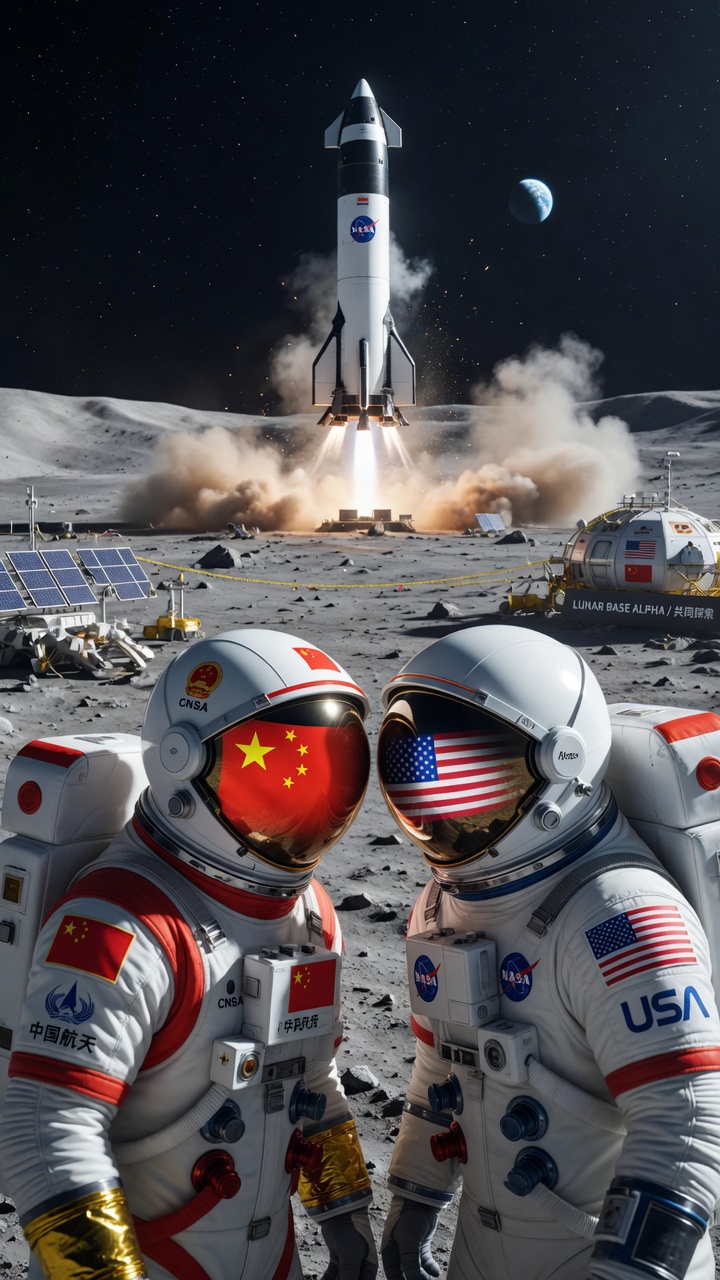
I’ve spent 20 years in IT — managing teams, building infrastructure that most people never see but everyone depends on. I’ve watched compute go from racks in closets to hyperscale data centres to the cloud. Every time, the pattern was the same: someone builds the platform, and then everything changes.
What’s happening right now in space is that pattern — except the platform is orbit, the Moon, and eventually Mars. And the scale makes cloud computing look like a toy.
This is Part 1 of a 6-part series called The New Frontier. Consider it the vision piece. I’ll paint the big picture, but every claim is grounded in filings, announcements, and hardware that exists as of April 2026. No hand-waving. No “someday.” Let’s go.
The New Age of Exploration
We are at an inflection point. Not since the Age of Exploration — when European ships set out for continents they couldn’t even see — has humanity faced a frontier this vast.
But there’s a crucial difference. The Age of Exploration was driven by monarchs, missionaries, and the promise of gold in unknown lands. The new frontier is driven by economics. Industrial orbit, a productive Moon, and a self-sustaining Mars are no longer the stuff of Asimov novels. They are becoming engineering problems with business cases, FCC filings, and hardware in production.
I keep coming back to a concept I’ll call the “frontier of independence” — the moment when a settlement, a station, a colony can survive and grow without daily resupply from Earth. That’s the line between an outpost and a civilisation. Every piece of what’s happening right now — Starship, orbital compute, lunar ISRU, Artemis — is a step toward crossing that line.
And the speed is staggering. In the last 90 days alone (January–April 2026), we’ve seen:
- SpaceX file for 1 million satellites for space-based AI compute
- A joint venture called TERAFAB announced to produce 1 terawatt/year of chips — 80% destined for space
- The Artemis Gateway cancelled and $20 billion redirected to a permanent lunar south pole base
- Artemis II launch and splashdown — the first humans beyond LEO since 1972
- Blue Origin file Project Sunrise — 51,600 satellites for orbital compute
- Elon Musk publicly pivot to a Moon-first strategy for Mars colonisation
If you’re reading this and thinking “this sounds like hype” — I get it. I’m an engineer. I’m allergic to hype. But I’m also allergic to missing inflection points. And this one has FCC docket numbers.
Part 1: Industrial Orbit — The World’s New Server Room
Low Earth Orbit is no longer just the domain of communication satellites and the ISS. It is becoming, quite literally, the world’s server room and factory floor.
The Orbital Data Centre Revolution
On January 30, 2026, SpaceX filed an application with the FCC for a constellation of up to 1 million satellites — not for internet access, but for space-based AI compute. The FCC Space Bureau accepted the application for review on February 4, 2026.
Let that number sink in. One million satellites. For context, the Starlink internet constellation currently numbers around 10,000 active satellites — already the largest constellation in history, and already functioning as a planetary backbone for the internet. Starlink is a communications network independent of anything on Earth’s surface. We have, for the first time, a redundant internet that doesn’t rely on terrestrial infrastructure. The proposed orbital data centre constellation is two orders of magnitude larger than even that.
And it’s not for streaming Netflix — it’s for running AI inference and training in orbit.
Why would anyone put data centres in space? Because the physics actually make sense:
-
Constant solar energy: Above the atmosphere, solar irradiance is a steady 1,361 W/m². No clouds. No night cycle (with proper orbital placement — sun-synchronous orbits keep satellites continuously illuminated). No seasonal variation. On Earth’s surface, you average 150–300 W/m² after accounting for weather, atmosphere, and darkness.
-
Natural vacuum cooling: In space, radiative cooling works beautifully. You can run processors at much higher temperatures (~370 K / ~97°C) because you’re designing for radiative dissipation into the void, not fighting thermodynamics with air conditioning. Higher operating temperatures actually improve certain semiconductor efficiencies — for example, leakage current in modern FinFET transistors becomes predictable and manageable when chips are designed for a stable high-temp regime, and you eliminate the thermal cycling stress that kills components in terrestrial data centres where temperature fluctuates between idle and load.
-
No land constraints: A terrestrial hyperscale data centre needs hundreds of hectares, environmental permits, water rights, grid connections, years of construction — and no pesky protestors and activists blocking the build. In orbit, you need a launch vehicle and a parking spot.
-
No grid limits — and this is the killer: The problem isn’t just power generation. On Earth, even if you could build enough solar farms or nuclear plants, you’d still face the transmission bottleneck — getting that power from where it’s generated to where compute needs it. Building new high-voltage lines takes a decade of permitting, legal battles, and construction. Meanwhile, manufacturing sources of energy (solar panels, turbines, reactors) has itself become a supply-chain bottleneck — global demand outstrips production capacity. In orbit, energy production happens on-site — each satellite generates its own power from attached solar arrays. No grid. No transmission. No NIMBYism. The entire US electricity grid generates roughly 0.5 TW. The AI industry alone is projected to need multiples of that within a decade. Space solves both the generation and distribution problem simultaneously.
That last point is what makes this more than a thought experiment. We are running out of terrestrial power for AI. The grid can’t scale fast enough — not because we can’t generate more, but because we can’t build and deliver the infrastructure fast enough. Space has effectively unlimited solar energy with zero transmission overhead.
TERAFAB: The Chip Factory for Space
On March 21, 2026, SpaceX, xAI, and Tesla announced TERAFAB — a semiconductor manufacturing initiative targeting 1 terawatt per year of chip production capacity. Intel joined the venture on April 7, 2026. The stated plan: 80% of production is destined for space operations.
Let me put that in perspective. The entire current global semiconductor industry produces chips that consume maybe 50–100 GW in aggregate. TERAFAB is targeting 1,000 GW — a 10–20x increase — and most of it goes to orbit.
The chips themselves are custom-designed NPUs (Neural Processing Units) optimised for the space environment. Operating at ~370 K (~97°C), they take advantage of radiative cooling in vacuum rather than fighting it. No fans, no water cooling loops, no chiller plants. Just thermal radiators facing the cold of space.
Orbital Placement: Not Just LEO
A key nuance: SpaceX’s orbital data centre constellation won’t simply occupy Low Earth Orbit like Starlink. The FCC filing specifies multiple orbital shells at altitudes between 500 and 2,000 km, with sun-synchronous orbits as the primary configuration for data centre satellites — ensuring continuous solar illumination.
Communication satellites (Starlink) stay in LEO (~550 km) for low-latency coverage. Data centre satellites optimise for energy, not latency — so sun-synchronous and higher orbits make sense. Looking further ahead, Lagrange Point 1 (L1, the gravitational balance point between Earth and Moon, roughly 1.5 million km from Earth) could offer an even more compelling location for massive compute infrastructure: stable orbit, continuous solar exposure, and proximity to cislunar operations. That’s speculative for now — but the physics are inviting.
The Vertical Integration Play
Here’s what makes the SpaceX approach different from, say, Amazon launching a few compute satellites: vertical integration.
- SpaceX builds the rockets (Starship) and the satellite buses
- Starlink provides the laser-mesh inter-satellite networking — already proven with 10,000+ nodes forming a planet-independent communication backbone
- xAI provides the AI models (Grok) and the compute workloads
- Tesla provides robotics (Optimus) and energy systems (batteries, solar)
- Intel/TERAFAB provides the custom silicon
This isn’t a consortium hoping to coordinate. It’s a set of companies under one ecosystem building every layer of the stack. Launch, hardware, networking, compute, AI models, robotics, power. That’s a space-native cloud provider — vertically integrated from launchpad to inference endpoint.
The Competition Shows Up
SpaceX isn’t alone. On March 19, 2026, Blue Origin filed “Project Sunrise” with the FCC — a constellation of 51,600 satellites for orbital compute. Smaller than SpaceX’s million-satellite filing, but still enormous.
And Amazon’s Kuiper division — Blue Origin’s corporate cousin — promptly petitioned the FCC to deny SpaceX’s application, arguing spectrum interference and orbital debris concerns. The regulatory battle is already fierce.
This is exactly what you’d expect. When a new market opens, incumbents try to slow the leader through regulation while building their own competing plays. It happened with railroads, telecom, cloud computing, and now orbital compute.
The Challenges Are Real
I’d be doing you a disservice if I glossed over the risks:
-
Kessler syndrome: One million satellites across multiple orbital shells is an unprecedented density. A single catastrophic collision could cascade into a debris field that renders entire altitudes unusable. SpaceX’s application will need to demonstrate robust deorbit plans and collision avoidance. This is genuinely the biggest technical risk.
-
Capital requirements: We’re talking about enormous total investment over a decade-plus. But here’s where Wright’s Law and Moore’s Law both work in our favour. Wright’s Law (learning curve effect) tells us that for every cumulative doubling of units produced, costs fall by a consistent percentage — Starlink has already demonstrated this with satellite production costs dropping dramatically across 10,000 units. Moore’s Law continues to drive compute density up and cost per operation down. The per-satellite cost of the 100,000th unit will be a fraction of the first. This cost deflation benefits everyone — including competitors — and is the economic engine that makes a million-satellite constellation financially plausible rather than financially insane.
-
Unproven at scale: Nobody has operated a million-satellite constellation. Nobody has run production AI workloads in orbit. The engineering is plausible, but “plausible” and “proven” are different words.
That said — every infrastructure megaproject in history faced similar scepticism. The transcontinental railroad was called impossible. The internet was called a fad. Cloud computing was called insecure. The pattern: sceptics are right about the risks but wrong about the outcome.
Space Manufacturing Beyond Compute
Orbital data centres get the headlines, but LEO manufacturing has been quietly advancing in other areas:
- Zero-gravity pharmaceuticals: Protein crystals grown in microgravity are purer and more uniform, enabling better drug design. Companies like Varda Space Industries have already returned samples from orbit.
- ZBLAN fibre optics: This fluoride glass fibre, when manufactured in microgravity, has dramatically lower signal loss than terrestrial fibre. The theoretical improvement is 10–100x over conventional silica fibre. Producing it on Earth is nearly impossible due to crystallisation from gravity-driven convection.
- Advanced alloys and composites: Microgravity enables mixing of materials that separate under Earth’s gravity, opening up new material science possibilities.
These are niche today. But “niche” is where every industry starts. When Starship drops launch costs to $100–200/kg (near-term target) and eventually $10/kg (long-term with 1,000+ flights/year), the economics of orbital manufacturing transform completely.
Starship: The Railroad
Everything above depends on one vehicle: Starship.
Here’s the launch cost trajectory:
- Falcon 9 (current): ~$2,700/kg to LEO
- Starship V3 (first half 2026): Target ~$100–200/kg to LEO, with ~150 tonnes reusable payload capacity
- Starship V4 (in development): Target 200–300 tonnes to LEO
- Long-term (1,000+ flights/year): Target ~$10/kg to LEO
That’s a 100–270x reduction in launch costs over a few years. For comparison, that’s like going from express air freight rates to bulk container shipping costs. It doesn’t just make existing space activities cheaper — it enables entirely new categories of activity that were previously economically impossible.
Starship V3 is expected in the first half of 2026. Not a paper rocket — actual flight hardware.
This is the “railroad moment.” The transcontinental railroad didn’t just move things faster. It created industries, cities, and economic patterns that didn’t exist before. Starship is that railroad. Everything else — orbital compute, lunar bases, Mars colonisation — rides on it.
Part 2: The Moon — Humanity’s First Industrial Outpost
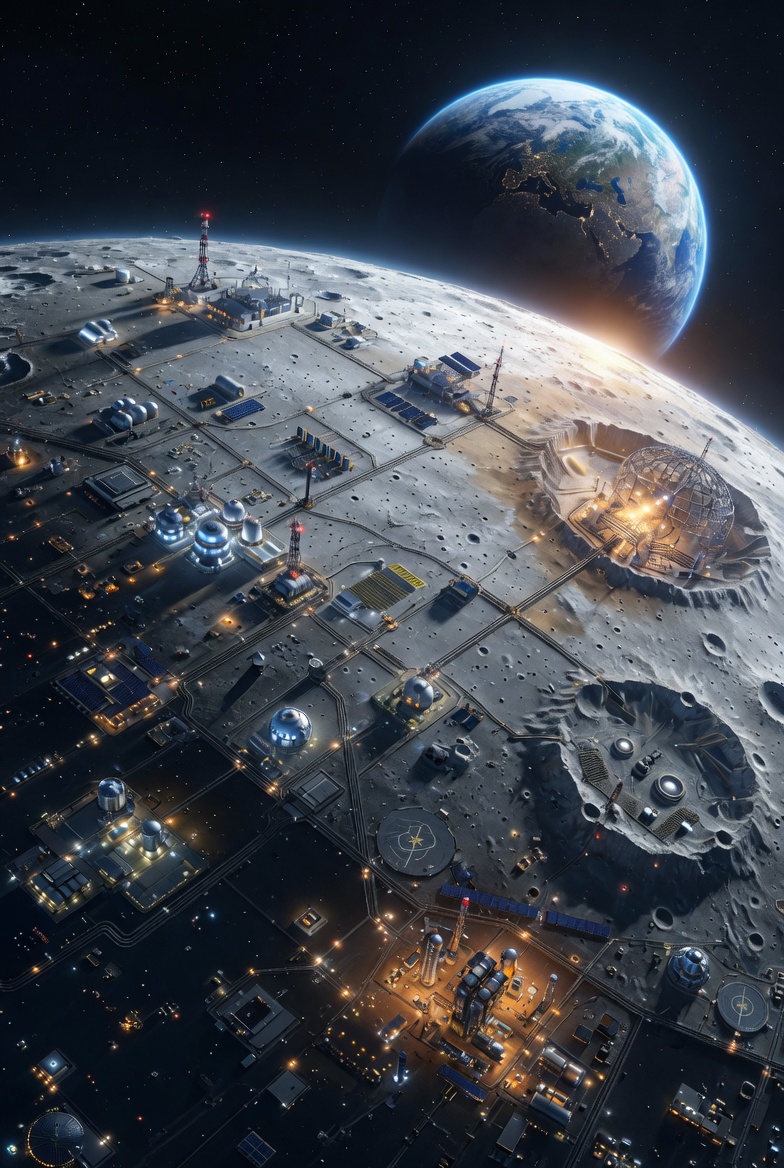
The Moon is not a destination. Thinking of it as a destination is like thinking of a port as a vacation spot. The Moon is a staging ground, a refinery, and a launchpad. It’s the logistics hub that makes everything beyond LEO economically viable.
Artemis: Where We Stand (April 2026)
The Artemis programme has undergone dramatic changes in the last two months. Here’s the current state:
-
Artemis II: Crewed lunar flyby. Launched April 1, 2026. Splashdown April 10, 2026. Four astronauts looped around the Moon and returned safely. This was the first time humans travelled beyond Low Earth Orbit since Apollo 17 in December 1972 — a gap of over 53 years. It happened. It’s done.
-
Gateway Station: Cancelled on March 24, 2026. The planned lunar orbital station was scrapped, and its approximately $20 billion in allocated funding was redirected toward building a permanent south pole surface base. This is a massive strategic pivot — from a visiting-scientist model to a permanent-presence model.
-
Artemis III (2027): Redesigned as a LEO test flight — no lunar landing. This tests the systems needed for landing missions in a lower-risk environment.
-
Artemis IV (early 2028): First crewed landing at the lunar south pole. Humans on the Moon’s surface for the first time since 1972.
-
Artemis V (late 2028): Begin base construction. The goal: establish infrastructure for continuous human presence.
-
Continuous human presence target: 2032.
-
Monthly robotic lander cadence starting 2027: A steady drumbeat of cargo and precursor missions to build up surface infrastructure before crews arrive.
This is an aggressive timeline. Whether NASA hits every date is debatable (they usually don’t). But the direction is unmistakable: permanent presence, not flags-and-footprints.
Why the South Pole Changes Everything
The Apollo missions went to equatorial regions. Interesting geology, great photos, but no long-term strategic value. The south pole is different — and the reason is water.
The lunar south pole has permanently shadowed craters — places where sunlight has literally never reached. Temperatures in these craters drop to around −230°C (40 K). At those temperatures, water ice is stable essentially forever. And we know it’s there — multiple orbital missions (LCROSS, Chandrayaan-1, LRO) have confirmed significant ice deposits.
Water ice on the Moon isn’t just for drinking. It’s rocket fuel.
- Electrolyse water (H₂O) → hydrogen (H₂) + oxygen (O₂)
- Liquefy them → LOX (liquid oxygen) + LH₂ (liquid hydrogen)
- LOX/LH₂ is one of the highest-performance chemical propellant combinations known
And right next to those shadowed craters? Peaks of eternal light — ridgelines and crater rims that are in near-continuous sunlight due to the Moon’s minimal axial tilt (1.5°). These provide nearly constant solar power for base operations.
So you have: water for propellant and life support in the shadows, and power on the sunlit peaks right next door. It’s the most strategically valuable real estate off Earth.
ISRU: Making Stuff From Moon Stuff
In-Situ Resource Utilisation (ISRU) is the technical term for “stop shipping everything from Earth and start making it locally.” It’s the key to crossing the frontier of independence.
Current ISRU development:
-
Blue Origin’s “Air Pioneer”: A system that melts lunar regolith (the dusty soil covering the Moon’s surface) and electrolyses it to produce medical-grade and propellant-grade oxygen. Regolith is roughly 40–45% oxygen by mass — it’s locked up in metal oxides (SiO₂, FeO, Al₂O₃, etc.), but it’s there.
-
Water ice extraction and processing: Multiple approaches being developed to mine ice from permanently shadowed craters, purify it, and electrolyse it into LOX/LH₂ propellant.
-
Regolith-based construction: Using lunar soil as aggregate for radiation shielding, landing pads, and structural elements. Several teams are developing sintering and 3D-printing approaches.
The endgame is turning the Moon into a giant propellant depot and launchpad. Once you can manufacture propellant on the Moon, you eliminate most of the need to launch fuel from Earth for missions beyond LEO. The Moon’s gravity well is only 1/6th of Earth’s, and it has no atmosphere — so launching from the lunar surface is dramatically cheaper in terms of energy (delta-v).
This is the economic pivot point. Lunar propellant makes cislunar operations, Mars transit, and asteroid missions economically viable in ways they simply aren’t when every kilogram of fuel starts at the bottom of Earth’s gravity well.
Lunar Manufacturing: Casey Handmer’s Vision
In February 2026, engineer and entrepreneur Casey Handmer (founder of Terraform Industries) published a detailed analysis of lunar manufacturing pathways. The core argument:
-
Start with solar panels and AI hardware manufactured from regolith minerals. The Moon’s surface is rich in silicon, aluminium, iron, titanium, and oxygen — the building blocks for photovoltaic cells and basic electronics.
-
Power bootstrapping: Initial power comes from deployed solar arrays brought from Earth, supplemented by Earth-beamed microwaves for locations in shadow. As lunar-manufactured solar panels come online, the power base grows exponentially.
-
Timeline: A functioning solar array production line on the Moon within ~10 years from first serious investment. That’s roughly 2035–2036.
-
Robotics: Tesla Optimus humanoid robots are well-suited for lunar surface operations. The Moon’s dust is abrasive and statically charged — murder on precision equipment — but Optimus-class robots can be designed for dust tolerance and replaced when worn.
-
Gwynne Shotwell (SpaceX President) stated publicly that Moon settlements and manufacturing could be operational in 5–10 years.
The sequence is: bring the first tools from Earth → use those tools to make more tools from local materials → use those tools to make products → export products. It’s the same bootstrapping sequence every frontier colony in history has followed, from Jamestown to the American West.
The Lunar Export Economy
What does the Moon sell?
- Propellant (LOX/LH₂): The first and most valuable export. Every kg of propellant made on the Moon saves ~$500–5,000 of Earth launch costs (depending on destination).
- Metals: Iron, aluminium, titanium extracted from regolith. Initially for local use, eventually for orbital construction.
- Helium-3: Rare on Earth, relatively abundant in lunar regolith (embedded by solar wind over billions of years). He-3 is a potential fuel for aneutronic fusion reactors — no radioactive waste, if we can make fusion work. Current estimated value: ~$3 billion per tonne (speculative but backed by fusion research demand).
- Manufactured components: Parts for orbital data centres, satellite components, structural elements for space stations. Manufacturing in 1/6 g and launching from the Moon’s shallow gravity well is far cheaper than manufacturing on Earth and fighting through our atmosphere.
And here’s a critical advantage the Moon offers for exports: you don’t need rockets to launch cargo off the surface. The Moon has no atmosphere and 1/6 g gravity. A lunar electromagnetic launcher (mass driver) — essentially a maglev railgun for cargo — can accelerate payloads to escape velocity (~2.4 km/s) along a track on the surface. No propellant consumed. Just electricity. This concept has been studied since Gerard O’Neill’s work in the 1970s, and with modern superconducting magnets and solar power, it’s increasingly feasible. Imagine a cargo railgun on the lunar surface, flinging containers of propellant, metals, or manufactured components into lunar orbit or onto transfer trajectories — powered entirely by solar electricity. The economics of lunar exports change dramatically when your “launch vehicle” is a powered track with zero fuel cost.
Initially, the delta-v economics favour high-value, low-mass exports — propellant and specialty materials. As infrastructure scales (especially with mass drivers), heavier and lower-value goods become viable. This is exactly the same trade pattern that colonial economies followed: spices and gold first, then lumber and grain.
Part 3: Mars — The First Independent World

Mars is the ultimate test of the frontier of independence. The Moon is close enough that you can call home in real-time (1.3-second light delay) and get a resupply in days. Mars is months away, with a communication delay of 4–24 minutes each direction. You can’t phone Houston for help. You can’t wait for the next supply ship if something breaks.
Mars is where humanity either proves it can build a self-sustaining civilisation off Earth — or it doesn’t.
The Moon-First Pivot
In February 2026, Elon Musk publicly shifted SpaceX’s Mars strategy to a Moon-first approach. This was a significant change from years of “Mars direct” rhetoric.
The reasoning is pure engineering pragmatism:
- Launch windows: Moon transfer windows occur roughly every 10 days. Mars transfer windows (Hohmann transfers) occur every 26 months. If something goes wrong on a lunar mission, you can try again in two weeks. If something goes wrong on a Mars attempt, you wait over two years.
- Iteration speed: The Moon lets you test technologies — ISRU, closed-loop life support, habitat construction, long-duration human operations — with a ~3-day trip home if things go sideways. Mars offers no such safety net.
- Infrastructure buildout: Lunar propellant depots, manufacturing capabilities, and operational experience all directly reduce the risk and cost of Mars missions.
This is an engineer’s decision, not a dreamer’s. Get the reps in close to home before going deep.
Mars Timeline
As of April 2026, the working timeline:
- 2028 (possibly): Uncrewed Starship to Mars. This would be a technology demonstration — can Starship survive the ~7-month transit, enter Mars’s atmosphere, and land intact? The 2028 Mars transfer window opens around October 2028.
- ~2030: First crewed Mars mission. Still aggressive, but Starship’s rapid development and the Moon-first strategy make it more plausible than it sounded five years ago.
- 2045–2055: Self-sustaining Mars city. Musk has used the “20–30 year” timeframe for a Mars settlement that doesn’t require regular resupply from Earth.
That last milestone — self-sustaining — is the one that matters. Everything before it is exploration. That’s the frontier of independence.
How the Moon Enables Mars
The Moon isn’t a detour on the way to Mars — it’s the critical path.
-
Propellant from lunar ISRU: A Mars-bound Starship refuelled in lunar orbit with Moon-produced propellant doesn’t need to carry all its fuel from Earth. This dramatically reduces the number of tanker flights needed and the total cost per Mars mission.
-
Closed-loop life support, tested: Mars crews need air, water, and food recycling systems that work for years without maintenance from Earth. The Moon gives you a 3-day-trip-home testbed to iterate on these systems. Fail on the Moon, fix it, try again. Fail on Mars, people die.
-
Manufacturing expertise: Everything learned about extracting resources from regolith, manufacturing with local materials, and building habitats in hostile environments transfers directly to Mars. Mars has different resources (CO₂ atmosphere, different mineral mix, subsurface water ice) but the engineering patterns are the same.
-
Orbital data centres as the “brain”: Here’s a connection people miss — orbital compute infrastructure isn’t just about running AI queries. It provides the AI backbone for autonomous operations on the Moon and Mars. Real-time simulation, supply chain optimisation, robotic control, predictive maintenance, scientific analysis. A Mars colony can’t wait 24 minutes for a response from Earth. It needs local AI infrastructure, and that infrastructure is being built in orbit right now.
The Frontier of Independence
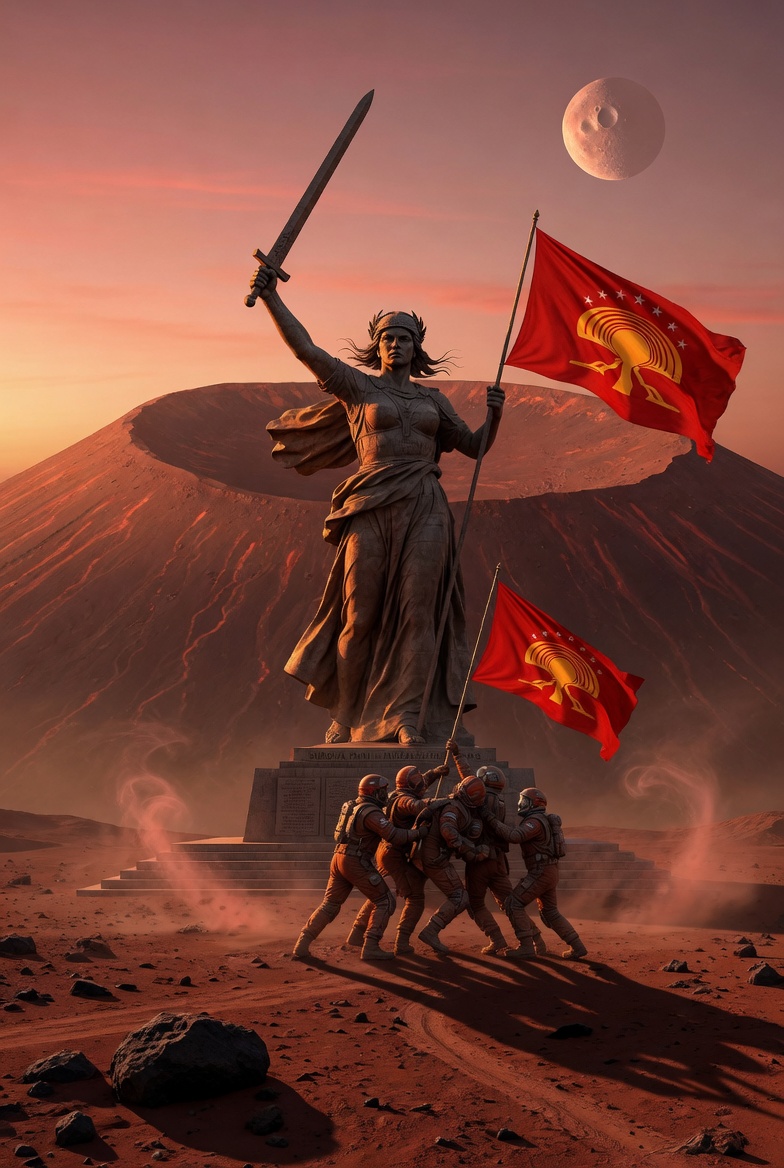
What does a self-sustaining Mars settlement actually need?
- Energy: Mars receives about 590 W/m² of solar irradiance (43% of Earth’s). Solar works but is less efficient than on the Moon or in orbit. Nuclear (fission, eventually fusion) is likely necessary for industrial-scale power.
- Atmosphere processing: Mars’s atmosphere is 95% CO₂ — a feedstock for oxygen (via electrolysis) and methane (via Sabatier reaction with hydrogen). SpaceX’s Raptor engines run on methane/LOX, so Mars can theoretically produce its own rocket fuel.
- Water: Subsurface ice confirmed at multiple latitudes. Extraction is an engineering problem, not a discovery problem.
- Food: Hydroponics and controlled-environment agriculture. Mars’s soil (regolith) contains perchlorates that need to be processed, but the mineral content is otherwise workable.
- Manufacturing: The big one. A self-sustaining colony needs to manufacture everything from screws to semiconductors locally. This is decades away but is the actual definition of independence.
The moment a Mars settlement can sustain its population and grow without regular Earth supply ships — that’s not a base. That’s not an outpost. That’s a civilisation. The first human civilisation not on Earth.
Part 4: The Economics of the New Frontier

I’ve spent my career building infrastructure that generates revenue. Space is no different — the question isn’t “is it cool?” but “does it cash-flow?”
The Frontier Expansion Model
Chamath Palihapitiya laid out a framework on the All-In Podcast that resonated with me because it maps perfectly to every infrastructure revolution I’ve studied:
- Build infrastructure → Starship is the railroad. It makes physical access to the frontier economically viable.
- Communication → Starlink provides the networking layer. Already a planet-independent backbone serving 10,000+ satellites. You can’t run an economy without communication.
- Services follow → Once you have transport and communication, every other economic activity becomes possible — from entertainment to heavy industry.
- Economy self-sustains → The frontier generates more value than it consumes. It stops needing subsidies.
Every frontier in human history followed this pattern. The American West: railroad → telegraph → towns/industry → self-sustaining economy. The internet: backbone infrastructure (ARPANET) → protocols (TCP/IP) → services (web, email) → the digital economy.
Space is following the same playbook at an accelerated pace.
The Vertical Integration Advantage
What makes the current moment unique is the degree of vertical integration under one ecosystem:
- SpaceX: Transport (Starship, Falcon, Dragon) + Communication (Starlink)
- Tesla: Energy (solar, batteries) + Robotics (Optimus) + Manufacturing expertise
- xAI: Compute (Grok models) + the demand signal for orbital data centres
- Intel/TERAFAB: Silicon production
This isn’t a government programme coordinating a dozen contractors. It’s a vertically integrated industrial stack that controls launch, communication, compute, energy, robotics, and manufacturing. That’s the complete set of capabilities needed for autonomous colonisation.
Is that monopoly concerning? Yes. Is it effective? Also yes. The same tension existed with Standard Oil, AT&T, and early Microsoft. The market usually resolves this after the infrastructure is built, not before.
The Revenue Sequence
When does space become cash-flow positive? Here’s the likely sequence:
-
Orbital compute (2–3 years): Musk has stated that space-based AI compute could be revenue-positive within 2–3 years. If the power economics work (free solar vs. escalating $/MWh terrestrial), even modest compute capacity in orbit generates enormous margins. This is the first revenue engine.
-
Cislunar propellant economy (late 2020s – early 2030s): Once lunar ISRU produces propellant at scale, selling fuel in lunar orbit to government and commercial missions creates a steady revenue stream. The value proposition is straightforward: lunar propellant is cheaper than Earth-launched propellant for anything beyond LEO.
-
Lunar manufacturing (2030s): Solar panels, structural components, and specialty materials manufactured on the Moon for use in orbit and on the lunar surface. Eventually, components for orbital data centres — made on the Moon and launched cheaply via mass drivers from the Moon’s shallow gravity well.
-
Mars (2040s–2050s): Mars becomes a net economic contributor only at very large scale. Initially, it’s a cost centre funded by the orbital and lunar economies. Long-term, Mars’s resource base and eventually its independent economy make it self-sustaining.
The critical insight: you don’t need Mars to pay for itself. The orbital compute and cislunar economies fund Mars development. Just as westward expansion in America was funded by eastern industrial capital long before the West was self-sustaining.
Part 5: The Geopolitical Race
Let’s talk about the elephant in the room: this isn’t just an economic competition. It’s a geopolitical one. And it has all the hallmarks of a new Cold War — this time, in cislunar space.
China and the ILRS
China’s space programme has been methodical, well-funded, and increasingly capable:
- Crewed lunar landing: Targeted for 2030. China’s Long March 10 heavy-lift rocket is in development specifically for this mission.
- International Lunar Research Station (ILRS): A full lunar base planned for 2035–2036, with 15+ international partners including Russia, Pakistan, UAE, and several others.
- Nuclear reactor on the Moon: Planned for deployment by 2036, providing the power base for industrial-scale operations.
- Approach: State-controlled, methodical, long-horizon. China’s space programme doesn’t need to justify quarterly earnings or survive election cycles.
The US/Artemis Approach
The US approach is fundamentally different:
- 30+ Artemis Accords signatories: A broad international coalition, including most Western nations, Japan, South Korea, India, and others.
- Commercial innovation: The primary advantage. SpaceX, Blue Origin, and dozens of smaller companies provide competition and innovation that state programmes can’t match.
- Bureaucratic drag: NASA is slow. Congress changes priorities. Funding is politicised. The Gateway cancellation shows a willingness to course-correct, but the structural inefficiencies remain.
What They’re Competing For
This isn’t about planting flags. The strategic stakes:
-
South pole water ice: A limited, localised resource. The best deposits are in specific permanently shadowed craters. First-mover advantage matters — not in terms of sovereignty claims (prohibited by the Outer Space Treaty) but in terms of operational infrastructure on the ground. If your base, your mining equipment, and your processing plants are already there, that’s a de facto claim regardless of treaty language.
-
Helium-3: If fusion power works (and multiple approaches are showing progress), He-3 becomes one of the most valuable substances in the solar system. The Moon has billions of years of solar-wind-deposited He-3 in its regolith.
-
Orbital dominance: Control of orbit means control of global communications, surveillance, and potentially compute infrastructure. If space-based data centres become a significant fraction of global AI compute, whoever controls the orbital infrastructure controls a critical economic resource.
Two Blocs Forming
The alliance structure is crystallising:
- ILRS bloc: China, Russia, and primarily non-Western partners. State-directed, patient, resource-focused.
- Artemis Accords bloc: US, Europe, Japan, Australia, South Korea, and commercial partners. Market-driven, innovative, but politically inconsistent.
This isn’t speculation — it’s visible in every international space forum, in UN COPUOS meetings, and in the bilateral agreements being signed.
The Treaty Problem
The 1967 Outer Space Treaty — the foundational document of space law — was written for an era when space was about exploration, not industry. It says:
- Space is free for exploration by all nations
- No national sovereignty claims on celestial bodies
- Space shall be used for peaceful purposes
What it doesn’t address: commercial resource extraction, property rights for extracted materials, exclusive use of specific locations, or private enterprise operations at scale.
The Artemis Accords attempt to create a framework for resource utilisation within the treaty structure, but China and Russia reject them. The ILRS operates under a different set of bilateral agreements.
We’re heading for a period where two competing legal and operational frameworks govern activity on the Moon. That’s not stable. It’ll either be resolved through negotiation or through facts on the ground.
Why This Matters to You
I started this article with a claim: we’re at an inflection point not seen since the Age of Exploration. Let me be specific about why you — whether you’re an engineer, a manager, an investor, or just someone who looks up at the sky — should care.
This isn’t science fiction anymore. It’s FCC docket numbers. It’s congressional appropriations bills. It’s flight hardware in thermal vacuum chambers. It’s Artemis II splashing down five days ago with four humans who just flew around the Moon.
The numbers are real:
- $2,700/kg → $10/kg launch costs within a decade
- 1 million satellites filed for orbital compute
- 1 TW/year chip production facility announced
- $20 billion redirected from Gateway to a permanent lunar base
- 2032 target for continuous human presence on the Moon
- 2045–2055 for a self-sustaining Mars city
These aren’t aspirations scribbled on a whiteboard. They’re engineering programmes with timelines, budgets, and people working on them right now.
The biggest infrastructure project in human history is unfolding in real-time. The frontier is open. The question isn’t whether we’ll industrialise space — it’s who gets there first, and what they build when they do.
As someone who’s spent two decades building systems, I can tell you: the most exciting moment in any infrastructure project is when the platform goes live and people start building things on it you never imagined. Starship is about to go live. The Moon is being surveyed for construction. Orbital data centres are in FCC review.
We’re about to find out what humanity builds when the constraints come off.
What’s Next in This Series
This was the vision piece — the big picture of where we’re headed and why. The next five articles will dive deep into the specifics:
- Part 2: The Timeline → — A detailed roadmap of what’s planned, what’s funded, and what’s realistic from 2026 to 2060.
- Part 3: Payload Economics → — The maths behind Starship’s cost revolution, orbital manufacturing margins, and when space industry becomes cash-flow positive.
- Part 4: Lunar Industrialisation → — Deep dive into ISRU, regolith processing, solar panel manufacturing, propellant depots, mass drivers, and the lunar export economy.
- Part 5: The Mars Jump — How Moon infrastructure enables Mars colonisation, the closed-loop life support challenge, and what “self-sustaining” actually means.
- Part 6: Risks and Geopolitics — Kessler syndrome, regulatory capture, the new Cold War in cislunar space, treaty inadequacy, and what could go wrong.
If you want to follow along, subscribe to the RSS feed or check back at sajna.space. I’ll be publishing roughly one per week.
The frontier is open. Let’s understand it.
Krzysztof Sajna is an IT engineering manager who spends too much time reading FCC filings and not enough time sleeping. He writes about space, technology, and infrastructure at sajna.space. Opinions are his own.